Showing posts with label Rosebank. Show all posts

Friday, October 21, 2022

Lost Small Churches of the North Shore: Italian Presbyterian, aka Our Saviour


194 St. Marys Ave. - Our Saviour, aka Italian Presbyterian Church, ca. 1940

Here's an addendum to the previous post about Olivet Presbyterian Church in West New Brighton. A commenter on Facebook mentioned the founding pastor of Olivet, Joseph DeRogatis, was her uncle and that he'd also had an Italian mission church in Rosebank. It's mentioned on Olivet's website, but neither the site nor the commenter knew where it had been. She did know her uncle lived on Chestnut. That was more than enough to point me to the correct map.


For those not aware, as late as the nineties, Rosebank was an intensely Italian neighborhood going back over a century. Giuseppe Garibaldi lived on Staten Island for a short period around 1850. The cottage he lived in serves as the Garibaldi-Meucci Museum today.


SI Advance May 28, 1955 

I have no idea when Our Saviour closed. By the time of the 1980s tax photos, the location was an empty overgrown lot. Searching back issues of the SI Advance didn't provide an answer, either. So, if you know anything, please let me know.


194 St Marys Avenue - 2018

Tuesday, July 28, 2020

High Church - North Shore Episcopalian Churches Pt. 4

St. John's Episcopal Church on Bay Street in Rosebank, like Christ Church, is another monument to the importance of wealthy Episcopalians on Staten Island in days gone by. 

St. John's Episcopal Church, ca. 1940, 
built in 1871 to address congregational growth


St. John's Episcopal Church - 2013


St. John's Rectory - ca. 1940


St. John's Rectory - 2013


The parish began organizing in 1843 at the home of William B. Townsend. His estate was along Bay Street, then called New York Avenue, between Willow Avenue and Lynhurst Avenue (then called Maple Avenue). He and several other prominent Islanders, all of whom were “Protestant in the rejection of all unscriptural additions to the faith; Episcopal and Catholic in her creed, government and three-fold ministry,” were successful and charitable men. Several were members of the St. George's Society of New York and co-founders of the Society for the Relief of Destitute Children of Seamen, today called Seamen's Society for Children and Families. According to the church's website, the first baptism at St. John's was of Cornelius Vanderbilt II, one of Commodore Vanderbilt's grandsons. 


From St. John's website - the original church building

A decade ago, I wrote about the wedding of Miss Anne Flemming Cameron, third daughter of Sir Roderick Cameron, and Mr. Belmont Tiffany, grandson of Commodore Matthew Perry. You can see the picture and read about it HERE. It's hard to picture Staten Island as a preserve of the truly wealthy and notable, but once upon a time, it was the case. 

St. John's website is a treasure trove of pictures and details the parish's long and complex history: rectors came and went, the congregation grew and then shrank as mainline Protestantism waned in the latter third of the twentieth century, and plans were made to help the church survive by building housing for seniors. In all my life, I've only known one person who ever attended St. John's. The one time I was on the grounds was when I attended some meetings for the Order of the Arrow at the old parish hall. That the parish survives despite the fading away of Episcopalianism and the drastically changed demographics of Rosebank would seem to be an indicator of God's grace. 


From St. John's website - Nativity Windows
See the rest of the windows HERE

The one lasting legacy I could have identified up until last year was St. Simon's Episcopal Church over on Richmond Road. It was founded as a German mission in 1856 on Targee Street before moving Clove Road, and in 1960, to Richmond Road when the Staten Island Expressway was built. Last year, after 156 years, citing an aging and diminished congregation, it closed.


Thursday, July 10, 2014

Bay Street - Looking west toward Hylan Boulevard


To look at the buildings on Bay Street in the past and then today, it's as if they've melted. The intricate details that were just bits and pieces of the original construction but gave the buildings character have been stuccoed or covered with sidings. Attractive canvas awnings have given way to vinyl or plastic ones. I appreciate these are old buildings that need alterations if they're to survive as actual working buildings but it's a little sad.


But then, hey, it's why when a building gets landmarked it can bankrupt the owner. Too keep a building even looking like it used to, forget about using "period" repair items, tends to drive out owners without lots of extra cash on hand. Too many folks don't really care much about what happens to the owners of such properties, just that their perfectly imagined bits of history are preserved in amber.

Here's a great little detail for the transportationally minded: horse, cars, and trolleys, all living together.


Wednesday, May 25, 2011

Belair Road - Hidden Jewel in the Crown

Some might argue that Belair Road is really part of Shore Acres. Feh. For me, Shore Acres only includes that area between Bay Street and the water. I place this little traveled street squarely in the neighborhood of Rosebank.


Winter - looking southward from in front of 37 Belair Road - 1934


View Larger Map


25 Belair Road - 1934


View Larger Map

While the decorative supports for the porch roof have been lost a zoom in on it will show the beautiful scrollwork eaves have survived.


18 Belair Road - 1934


View Larger Map

Today the hedges have been allowed to grow over the columns standing astride the entrance walk and the tree in the front yard towers high above the roof of this quaint Mediterranean style house.


59 Belair Road - 1934


View Larger Map

Oddly unpainted but largely intact - sorry about the telephone pole


I'm finding I'm having a much tougher time creating posts about Rosebank that I thought I would. Most of my work is predicated on what I can find digging through NYPL's digital collection. While I'm finding numerous good shots of Rosebank's beautiful and often stately homes, I'm finding few images of the neighborhood's commercial structures.

Oh, there are a few specific shots, but most are like the stores I put up that were essentially background images on Rosebank's Tangled Backstreets. So far I'm having little luck with pictures showing Bay Street in its past glory which seems odd. I mean we're talking about a stretch of major road from Vanderbilt Avenue to at least Hylan Boulevard and I'm getting next to nothing. So there's a bunch of work I need to do and it means getting up off my rump and going to the St. George Library. Oh, well.

Saturday, May 07, 2011

Rosebank's Tangled Backstreets

Reynolds Street, 1934 - looking east from Bell Street to St. Mary's Avenue

View Larger Map

To the southeast of the intersection of Tompkins Avenus and Hylan Boulevard is a near maze of narrow streets and old houses. It's a physically fascinating remnant of the sorts of old working class neighborhoods that have been vanishing since at least before I was born. Witness the disappearing bungalows of Midland Beach or the neighborhoods that once existed where the Stapleton or West Brighton Projects are today.


View Larger Map

White Plains Avenue from Bell Street, 1934

I first encountered this little section during a low speed chase between friends back in the mid-eighties. The car I was in quickly became lost but the Rosebank's labyrinth remains etched in my mind to this day.


View Larger Map

Pigeon Coops at the Northeast corner of Oak and Bell Streets, 1934

One of the things you find doing this is that once there were stores sprinkled throughout residential areas away from the more developed commercial areas. I can't tell what the store in the below picture's right is but the one on the left's awning appears to read "Italian Deli"


View Larger Map

Till next time, same Rosebank Time, same Rosebank Channel

Tuesday, May 03, 2011

Rosebank - A Place I Don't Know


When I was young, every Thursday night, my grandfather would take my mom and my aunt grocery shopping at the A&P in Rosebank. It was one of the biggest supermarkets on the North Shore at the time and my grandfather knew people working in the butcher shop. And that was about the extent of my interaction with the neighborhood.

The only other thing I knew was that it was Italian, and pre-bridge non-Brooklyn Italian at that. Giuseppe Garibaldi had lived there in 1850-1851 and his house was preserved as a museum.

Rosebank had a bad reputation as being a very insular and somewhat racist neighborhood. In 1988 a young black man named Derek A. Tyrus was hit and killed by a car while being chased by a gang of white guys. But that's 23 years ago.

It wasn't until I went to work for the Police Athletic League in 1995 and started driving all over the Island that I started becoming familiar with Rosebank. When I went to work for City Hall in the late 90's I really got to discover the neighborhood in greater detail and it's an easy place to love. There are quiet, tree lined streets, odd, little twisting back streets and large, commercial strips. Many beautiful older homes survive and their are three churches, elevated train tracks and old factory complexes, all side by side.

Today it's a much more integrated place. There has been a lot of commercial development along Bay Street and many of the beautiful older homes on Rosebank's sidestreets have been demolished and filled with the usual array of Staten Island attached nightmares.

So, here goes. In an effort to learn a little more about the place myself and for your edification I'm dedicating the next series of posts to Rosebank

Sunday, December 26, 2010

A Staten Island Wedding

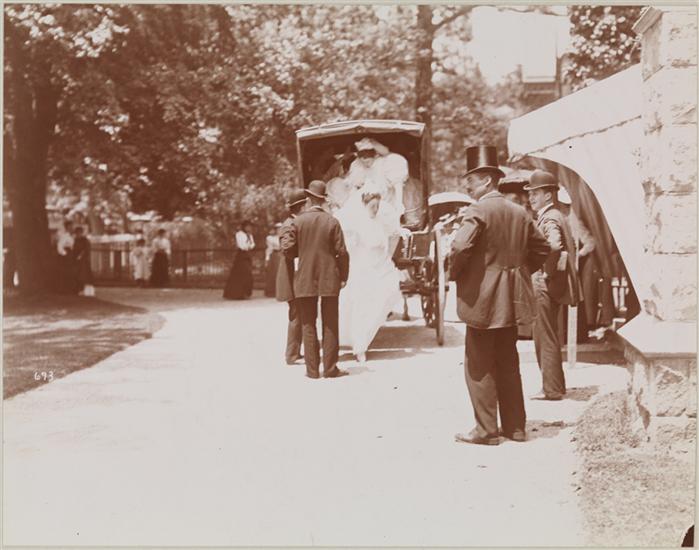
I was informed by Mrs. B. about the Museum of New York's photo archives when she sent me the following picture asking if I knew what church it was. I was pretty sure it was St. John's Episcopal in Rosebank. It took a little digging to decide that it absolutely was St. John's. I checked present day images of the church on its own website, looked at the old maps to see if there was a house next to the church in the past (there was; a G.S. Schofield lived there), and finally drove past the church to do one last double check. I was right.

On June 1, 1895, Miss Anne Flemming Cameron, third daughter of Sir Roderick Cameron, married Mr. Belmont Tiffany, grandson of Commodore Matthew C. Perry, at St. John's Episcopal Church in Rosebank, Staten Island. Following the wedding they took carriages to the bride's father's 130-acre country estate in Arrochar, "Clifton Berley".


The Bride's Arrival at St. John's Episcopal Church

A little more digging turned up the following article from the New York Times on May 17, 1895. One of the things I've learned in digging into the history of Staten Island's golden age is that the very wealthy were very well documented.


Above - The Bride's Carriage Returns - Right - The church today


The Bride's Departure


Wedding Reception Photos - presumably this is at "Clifton Berley".

Further research told me that the couple divorced and both outlived their only son, George. Belmont ended up in the papers when he was sued by a widow for failing to live up to his promise to marry her. Mrs. Tiffany became a noted society decorator and decorate the Astor Estate on Bermuda. Later both ended up in the papers again when it seemed their son was arrested for drug addiction and committed to the Bloomingdale Hospital for the Insane.

Saturday, March 20, 2010

Theater Fix


The Lyric Theater - in Rosebank at the on Tompkins near Clifton


View Larger Map

Apparently you can buy this bit of Staten Island theatrical history.