Tuesday, June 14, 2022

Lost Apartments of the North Shore: the Baltimore Flats


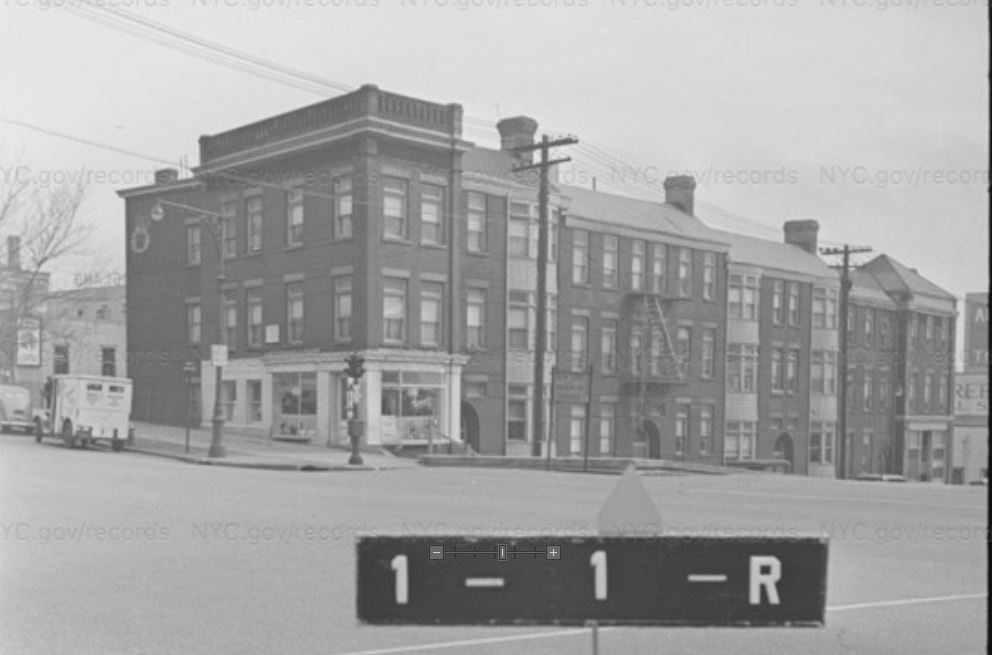
17-23 Victory Blvd, ca. 1940

When my parents got married, they lived at 115 Stuyvesant Place. It's where I lived my first three years. They bought a house on Cebra Avenue when their rent went up to $137 and exceeded a mortgage. As a baby, my mom and I went to all sorts of stores in St. George and Tompkinsville. I had memories of eating in a luncheonette at the corner of Victory and  Bay, but I couldn't remember anything specific about it except that my mom was friends with a waitress. It was only doing some research a few years ago that I discovered pictures of it.

The luncheonette was called DeFranco's and it was in the corner of a string of apartments called the Baltimore Flats. They're a beautiful example of late 19th-century buildings, designed by Edward A. Sargent. Unfortunately, after part of them caught fire in 1980, it wasn't long before the entire block of flats was demolished.


DeFranco's Luncheonette, 1969 - My mom and I could be inside 


Baltimore Flats on fire - 1980


the Baltimore Flats, 1980 - awaiting their fate


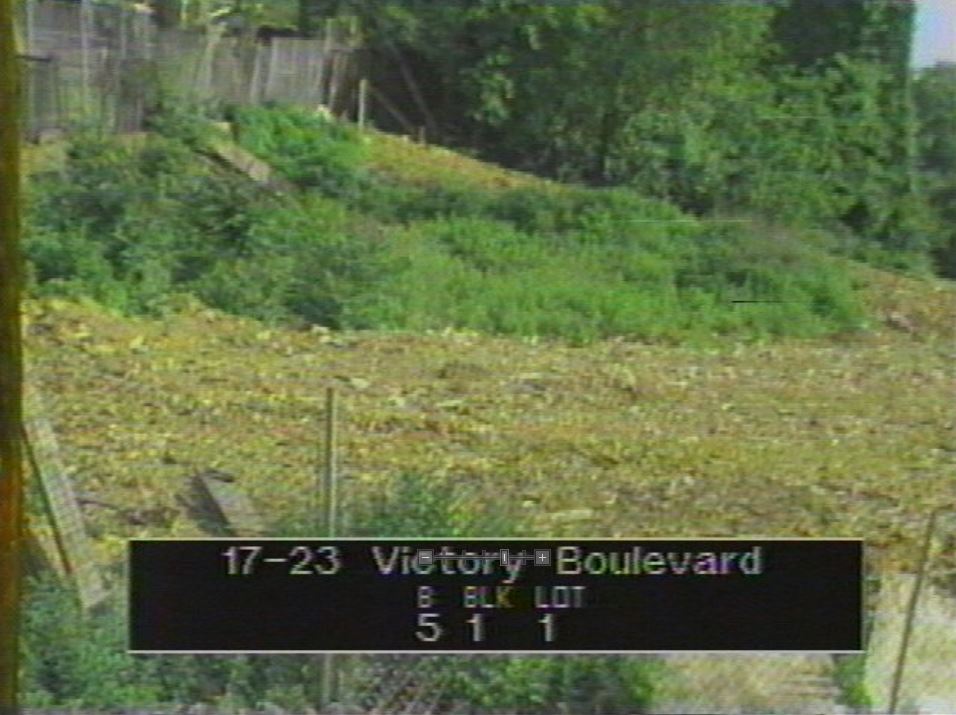
1989 - rubble


2021

Lost Apartments of the North Shore: 210 Victory Boulevard


                                                            210 Victory Boulevard, ca. 1940


   I have only the slightest memories of this building, even though I grew up a few blocks away and probably walked past it hundreds of times before it was torn down in the early 2000s. I suspect the reason it never really registered in my mind is because it was set way back from Victory Boulevard and the property was no longer the nicely-maintained lawns and hedges depicted above, but a mass of uncontrolled trees and bushes. 

   When I was a kid, those set-back buildings had acquired a reputation for housing shady characters. A friend of mine lived in one of them - maybe even this one - and I visited once, and it was fairly creepy. 

   According to Dept. of Building records, in 2000, it was reported that the back of the building had collapsed and the front was in imminent danger of coming down. I've always been fascinated about the circumstances by which a perfectly decent building reaches a state where it's abandoned and left to ruin. Whole families lived there once. Hopes were hoped, dreams dreamed, and lives lived inside those walls. Now, it's not much more than a few photos. As such, I'm going to do a series of short posts about buildings similar to this one that once graced our streets and at some point - poof!- just seemed to vanish into the æther.

2013

1917 map


1996 NYC aerial map


Tuesday, August 04, 2020

Dutch Reformed Churches of the North Shore


From the Reformed Church on Staten Island site: 
Old North Church, built 1717

Reformed Church on Staten Island: The oldest church of any denomination on Staten Island is the Reformed Church on Staten Island in Port Richmond on Port Richmond Avenue. The Dutch and French-speaking Huguenot settlers of Staten Island prior to 1680 were few in number and unable to support a permanent minister. Instead, preachers traveled to the Island every couple of months. In, Petrus Tesschenmacker, the first Staten Island minister ordained in the New World, was received by the tiny village of Port Richmond (New Amsterdam had become an English possession in 1674). He left Port Richmond for Schenectady in 1686 where he and his congregants were killed by French and Indian raiders in 1690. 

From the Reformed Church on Staten Island site: 
Third church, built 1787

The first church building went up in 1680, and a second, hexagonal one, in 1717. That building was burnt by the British occupation forces in 1780, and a new one was built in 1787. Finally, in 1844, the present brick church was built, with expansions being added over the next few decades. Surrounding the church is a cemetery that dates back to the 1690s.

Present church, 1844

Like most mainline Protestant churches, the Reformed Church on Staten Island is past is prime. Its buildings are in need of repair and its congregation is small. What it does have is a terrific website that has a detailed history of the church and many of its historical documents and architecture on display.

Brighton Heights Reformed Church: While I only attended Brighton Heights Reformed Church for about two years in my forties, my paternal roots lie with that congregation's denomination. My father's family is Dutch and English. While I'm uncertain of exactly when, his Dutch antecedents arrived in New Amsterdam prior to the British takeover. Family tradition held they were employees of the Dutch West India Company

From the American Guild of Organists site: 
original 1820 building, ca. 1900

Whatever the real history is, Vredenburghs have lived in New York City - mostly Harlem, the Bronx, and, for the last fifty-five years, Staten Island - for over 350 years now. I have photos and membership papers from my dad's mom from her time as a member of Elmendorf Chapel on East 121st Street in Manhattan. During the time I attended Brighton Heights under the late Rev. Seawood, I felt very much at home and part of true Christian fellowship.

Looking north on St. Marks Place towards 1860s church, 1937

What's now Brighton Heights Reformed Church was founded in Tompkinsville in 1818 under the supervision of ex-NY governor (and later, vice-president), Daniel D. Tompkins and the spiritual supervision of the Rev. Peter I. Van Pelt of the church in Port Richmond. This seems to have grown out of Tompkins' earlier prompting of Van Pelt to hold services within the walls of the Quarantine Station located in Tompkinsville. This sort of direct community service was continued in the early eighties by Brighton Heights when it opened the first overnight homeless shelter on Staten Island. That undertaking would evolve into Project Hospitality, which still serves the Island's homeless individuals.

1860's church 

The original church was built in 1820, roughly at the corner of Van Duzer and St. Paul's. As the neighborhood became more commercial, land was bought on Brighton Heights, and a new church was built at the present location on the corner of Fort Place and St. Mark's Place in the 1860s. That building perished in an accidental fire during renovations in 1996. Finally, in March of 2000, Pastor Seawood led the congregation into the new building. 

Brighton Heights Reformed Church, present

Mariner's Harbor Reformed Church: This church, while it closed in 1974, has not stood vacant. I'm not sure when, but for many years it has been Fellowship Baptist Church. The building is on the corner of Richmond Terrace and Lockman Avenue. Leng and Davis have little to say about it. While claims were made it first organized in 1885, they state it was "not mentioned in the Chamber of Commerce report of 1896." It was incorporated in 1907. I imagine it closed due to Mariner's Harbor old Dutch residents moving to New Jersey and the general mainline Protestant decline. I've written to the denomination's archivist, and should I ever hear back, I'll post more details about the congregation and its history.

Mariner's Harbor Dutch Reformed Chapel, postcard

Mariner's Harbor Reformed Church, 4/23/32

Fellowship Baptist Church, present

Wednesday, July 29, 2020

High Church - North Shore Episcopalian Churches Pt. 5


St. Simon's movable church

   When I started posting about the North Shore's Episcopal churches last year, I didn't know that St. Simon's was about to close. Again, like St. John's, it wasn't a church anyone I knew attended. It was just a small, brick church I saw along a curve on Richmond Road. Despite its thoroughly modern architecture, it still had the red doors many traditionally-designed Episcopal churches have. Now, it's gone, and its presence stripped clean from the internet. 

St. Simon's brick building on Clove Road, ca. 1940

   From the Staten Island Advance, the amazing New York Chapters of the American Guild of Organists site, and St. John's Episcopal's site, I discovered, like many other churches on the Island, St. Simon's was founded as a mission congregation to immigrants. Under the direction of the Rev. Richard M. Abercrombie, the St. Simon’s Free German Chapel of the Protestant Episcopal Church was founded in 1854. It first operated from a small building on Targee Street before moving to the vacant First Baptist building. That wood frame church was moved to Rhine Avenue near Steuben, and later to Clove Road. In 1960, the construction of the Staten Island Expressway forced the relocation of the parish to Richmond Road. The new church was built and for almost sixty years served its member. The building remains, but the parish is gone, its surviving member presumably shuffled off to other congregations. Any shuttered congregation is a loss of community and a connection to history and place, but I bet, as is so often the case, the building will soon house another denomination and starting their own history in a place that's new to them.

St. Simon's Richmond Road building - 2018

   Stapleton, in the middle of the nineteenth century, was filled with Germans. On their own, the wealthy beer barons among them founded Trinity Lutheran on the corner of Beach and St. Paul's. Catholic Germans co-founded Immaculate Conception Roman Catholic Church on Targee Street, as well. As a member of Trinity, I always knew some of that history, and as I began studying Stapleton's past, I picked up some bits about Immaculate. St. Simon's past, though, is all new to me. I wonder how long the German influence there lasted. 

from the SI Advance - St. Simon's on Clove Road prior to demolition

   Trinity, which had called Pastor Frederic Sutter to inaugurate a more English-language direction for the church, still held German services into the early eighties. Finding the answer to this sort of question is a large part of the reason I started the Church Project so many years ago. Staten Island, no less than anywhere else in NYC, has a history of changing populations that reuse and repurpose the landmarks of the preceding residents. I guess this means I have to find and reach out to an archivist at the Episcopal Diocese of New York. 

From the NYC of the American Guild of Organists 
interior of St. Simon's

Tuesday, July 28, 2020

High Church - North Shore Episcopalian Churches Pt. 4

St. John's Episcopal Church on Bay Street in Rosebank, like Christ Church, is another monument to the importance of wealthy Episcopalians on Staten Island in days gone by. 

St. John's Episcopal Church, ca. 1940, 
built in 1871 to address congregational growth


St. John's Episcopal Church - 2013


St. John's Rectory - ca. 1940


St. John's Rectory - 2013


The parish began organizing in 1843 at the home of William B. Townsend. His estate was along Bay Street, then called New York Avenue, between Willow Avenue and Lynhurst Avenue (then called Maple Avenue). He and several other prominent Islanders, all of whom were “Protestant in the rejection of all unscriptural additions to the faith; Episcopal and Catholic in her creed, government and three-fold ministry,” were successful and charitable men. Several were members of the St. George's Society of New York and co-founders of the Society for the Relief of Destitute Children of Seamen, today called Seamen's Society for Children and Families. According to the church's website, the first baptism at St. John's was of Cornelius Vanderbilt II, one of Commodore Vanderbilt's grandsons. 


From St. John's website - the original church building

A decade ago, I wrote about the wedding of Miss Anne Flemming Cameron, third daughter of Sir Roderick Cameron, and Mr. Belmont Tiffany, grandson of Commodore Matthew Perry. You can see the picture and read about it HERE. It's hard to picture Staten Island as a preserve of the truly wealthy and notable, but once upon a time, it was the case. 

St. John's website is a treasure trove of pictures and details the parish's long and complex history: rectors came and went, the congregation grew and then shrank as mainline Protestantism waned in the latter third of the twentieth century, and plans were made to help the church survive by building housing for seniors. In all my life, I've only known one person who ever attended St. John's. The one time I was on the grounds was when I attended some meetings for the Order of the Arrow at the old parish hall. That the parish survives despite the fading away of Episcopalianism and the drastically changed demographics of Rosebank would seem to be an indicator of God's grace. 


From St. John's website - Nativity Windows
See the rest of the windows HERE

The one lasting legacy I could have identified up until last year was St. Simon's Episcopal Church over on Richmond Road. It was founded as a German mission in 1856 on Targee Street before moving Clove Road, and in 1960, to Richmond Road when the Staten Island Expressway was built. Last year, after 156 years, citing an aging and diminished congregation, it closed.


Tuesday, March 26, 2019

High Church - North Shore Episcopalian Churches Pt. 3

Just one church today. The old photos are dark so I decided to include newer shots to accompany each one.

St. Mary's Episcopal Church
On the corner of Castleton and Davis Avenues in West New Brighton, this beautiful little church shares its grounds with a parsonage and garage. Surrounded by medical offices, lawyers, and slightly rundown houses, it looks a little out of place these days. The parish was founded in 1848 and the present building is from 1905. 


Thursday, March 07, 2019

High Church - North Shore Episcopalian Churches Pt. 2

Here's another installment of Episcopalian churches.


Situated on a large, tree-filled corner of New Brighton (specifically Hamilton Park), Christ Church is a large, Gothic-style building. According to Wikipedia, it was built in 1904. The large attached parish hall was built in 1879 and remodeled in 1909. I don't have a date for the rectory, seen on the far left of the bottom picture, however.

I don't have any interior pictures of the church and that's a shame. I've was in the sanctuary once and it can only be described as beautiful. As someone who grew up very high Lutheran, my tastes definitely run toward the more elaborate and ornate. I get the theology behind a stripped down church but I definitely prefer something like Christ Church.

Christ Church - Franklin Avenue


I grew up attending Trinity Lutheran Church, just up the block from St. Paul's, but I've never been in it or known anybody who attended there. From the pictures on their website, it's another beautiful house of worship. 

The present building was constructed in 1866 to replace the older, wooden one that was across the street a block or so away.


Original St. Paul's Memorial Church - St. Paul's Avenue - date unknown


Map of St. Paul's Avenue - 1874


St. Paul's Memorial Church - St. Paul's Avenue - 1939/1940


St. Paul's - 2013


St. Paul's Parsonage - St. Paul's Avenue - 1939/1940


St. Paul's Parsonage - 2013

Thursday, February 28, 2019

High Church - North Shore Episcopalian Churches Pt. 1

The Episcopalian Churches: Part 1

Once upon a time, the Episcopalian Church was the denomination of America's elite. Eleven of our forty five presidents were Episcopalians. Today, with under 2 million members, it's a dwindling church, like most mainline Protestant churches. The whys and wherefores of that are a conversation for a place other than this site.

What matters here are the gorgeous houses of worship raised by the Episcopalian Church. Once upon a time, when it was wealthy and filled with people willing to dedicate that wealth to such construction, it raised some of the most beautiful buildings to ever grace Staten Island, something for which we should all be grateful.

So, let's start with one of the lost churches of the Island. They're not really lost, but instead moved or destroyed.

Church of the Ascension

Built as an offshoot of Trinity Church in Manhattan, the Church of the Ascension was established 1802 on a small hill overlooking the Kill Van Kull. Situated on Richmond Terrace between Alaska Street and Tompkins Court, in the 1920s area industrialized, and the congregation decided to move the building to Kingsley Avenue near Clove Lakes. The 1929 Crash made this impossible, and the original church was left behind. You can see a FOR SALE sign in the picture below (1939 or 1940).

Church of the Ascension Parsonage - Richmond Terrace and Van Street
Church of the Ascension, sans steeple top - Richmond Terrace


from the church's own website - priest and congregation

Church of the Ascension in all its steepled-glory - 1930

The present Church of the Ascension is a small, brick building tucked away in a lovely section of Castleton Corners.


This church began as a Sunday school (for adults), in 1889. It gradually evolved into a full church and moved around to various locations in Mariners Harbor before buying a plot of land on the corner of Richmond Terrace and Van Name Avenue. In 1909, they acquired the Floating Church of Our Saviour, previously operated by the Seamen's Institute out in New York harbor. Go to this page to see a series of pictures of building at sea and on land.


It was docked at the foot of Van Name and in 1914 was moved to solid ground. In 1959, it burned down. The congregation, its cost not fully covered by insurance, bought new property on Wooley Avenue and Victory Boulevard and built the present church.


Floating Church of Our Saviour on its way to becoming All Saints' Church
1909

All Saints' Church - Richmond Terrace and Van Name Street - 1939/1940


All Saints' Church - present - Victory Boulevard